
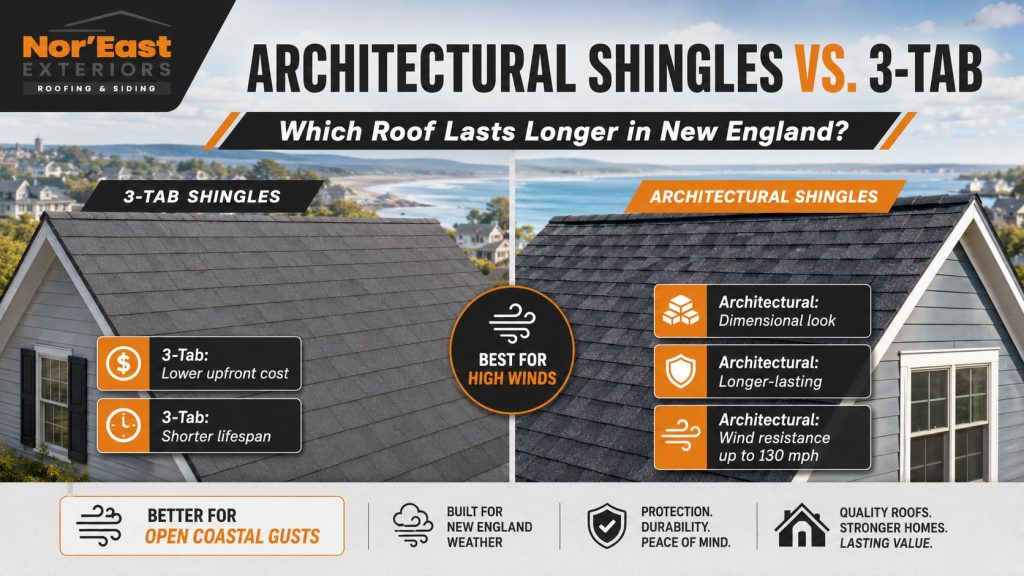
When Connecticut homeowners compare architectural shingles vs 3 tab, the question usually comes down to budget versus durability. A 3-tab roof may cost less upfront, but a modern architectural shingle roof is usually the stronger long-term investment, especially for homes exposed to shoreline winds, heavy rain, snow, ice, and New England freeze-thaw cycles.
At Nor’East Exteriors Roofing & Siding, we help homeowners choose roofing materials that match the house, the budget, and the weather conditions around the Connecticut shoreline. Our team provides roof repair, roof replacement, siding, gutters, and exterior services across Westbrook, Old Saybrook, Clinton, Madison, Guilford, East Lyme, Old Lyme, Essex, Chester, Killingworth, Branford, East Haven, Waterford, and nearby Connecticut communities. Nor’East Exteriors is licensed and insured in Connecticut, locally owned and operated, and certified by manufacturers including GAF, Owens Corning, and TAMKO.
What Are 3-Tab Shingles?
3-tab shingles are traditional asphalt shingles with a flat, uniform appearance. Each strip has cutouts that make it look like three separate tabs once installed. For many years, 3-tab shingles were the standard choice for budget-friendly roofing.
3-Tab Shingle Advantages
- Lower upfront material cost
- Simple, traditional appearance
- Lightweight design
- Familiar option for older homes
- Works for some basic roofing projects
3-Tab Shingle Drawbacks
- Thinner than architectural shingles
- Flatter appearance
- Usually shorter lifespan
- Lower wind resistance
- Less dimensional curb appeal
- More vulnerable to uplift in storm-prone areas
- Often less attractive for long-term resale value
For a mild climate and a tight budget, 3-tab shingles can still serve a purpose. For coastal Connecticut and New England weather, they are rarely the best durability choice.
What Are Architectural Shingles?
Architectural shingles, also called dimensional shingles or laminated shingles, are thicker asphalt shingles made with multiple layers. They create a textured, dimensional look that can resemble wood shake or a premium roof profile.
Most CT homeowners now choose high-quality architectural shingles for full roof replacement, according to Nor’East Exteriors’ Connecticut roof replacement guide.
Architectural Shingle Advantages
- Better wind resistance
- Longer expected roof life
- Thicker and more durable construction
- Stronger curb appeal
- Better dimensional appearance
- More manufacturer warranty options
- Stronger long-term value
- Better fit for exposed shoreline homes
Architectural Shingle Drawbacks
- Higher upfront cost than 3-tab
- Heavier than basic 3-tab shingles
- Requires proper installation for full performance
- Best results depend on a complete roofing system, not shingles alone
Architectural Shingles vs 3 Tab: Quick Comparison
| Feature | 3-Tab Shingles | Architectural Shingles |
|---|---|---|
| Appearance | Flat and uniform | Dimensional and premium |
| Upfront Cost | Lower | Higher |
| Durability | Basic | Stronger |
| Wind Resistance | Lower | Higher, many products rated for high-wind systems |
| Lifespan | Usually shorter | Usually longer |
| Curb Appeal | Standard | Stronger visual impact |
| New England Fit | Budget option | Better long-term choice |
| Best For | Lower-cost repairs or limited budgets | Full roof replacement and long-term value |
Which Roof Lasts Longer in New England?
In most cases, architectural shingles last longer than 3-tab shingles. The thicker laminated design gives architectural shingles better durability against wind, rain, snow, ice, and normal aging.
A roof’s actual lifespan depends on more than the shingle type. It also depends on:
- Installation quality
- Attic ventilation
- Roof pitch
- Deck condition
- Underlayment
- Flashing details
- Ice and water protection
- Coastal wind exposure
- Tree cover and shade
- Maintenance
- Storm history
A common homeowner question is how long does an asphalt shingle roof last. Many asphalt roofs fall in the 20 to 30 year range, while higher-quality architectural systems may last longer when installed correctly and maintained well. The Spruce reports asphalt shingles as a common residential option and notes that roof lifespan depends heavily on material, installation quality, climate, maintenance, slope, and ventilation.
Why Wind Resistance Matters So Much on the Connecticut Shoreline
For homes near Long Island Sound, wind resistance is not optional. Open coastal gusts can lift weak shingles, damage edges, expose underlayment, and create leak paths. Once wind gets under a shingle, the damage can spread quickly.
Architectural shingles are generally a better choice for homeowners searching best shingles for high winds because many modern laminated shingles are engineered for stronger wind performance than traditional 3-tab products.
For example, GAF Timberline HDZ shingles can qualify for GAF’s WindProven Limited Wind Warranty with no maximum wind speed limitation when installed with the required combination of qualifying GAF accessories.
That matters because the shingle alone is not the whole roof. Wind performance depends on the complete system, including:
- Proper starter strip
- Correct nailing pattern
- Ridge cap shingles
- Underlayment
- Leak barrier
- Flashing
- Ventilation
- Installer workmanship
Why “Up to 130 MPH” Matters
Many architectural shingles are marketed with wind resistance ratings up to 130 mph when installed according to manufacturer requirements. For Connecticut shoreline homes, that level of protection can be a major reason to upgrade from 3-tab shingles.
A high-wind shingle can help reduce the risk of:
- Lifted shingles
- Missing shingles
- Wind-driven rain intrusion
- Edge failure
- Exposed nail heads
- Emergency storm repairs
- Premature roof replacement
However, the rating only matters when the roof is installed correctly. A premium shingle installed poorly can still fail. A certified installation helps protect the warranty and gives homeowners better confidence in the system.
Roof Replacement Cost: Why Architectural Shingles Cost More
Homeowners often compare roof replacement cost before choosing materials. Architectural shingles usually cost more than 3-tab shingles, but the price difference should be viewed through long-term performance.
Nor’East Exteriors’ 2026 Connecticut roof replacement guide states that a full roof replacement for a standard 2,000-square-foot CT home typically ranges from $10,000 to $20,000 or more, depending on materials, management, and method.
Architectural shingles can raise upfront cost because they are thicker, heavier, more durable, and often paired with stronger warranty systems. That investment can make sense when homeowners want:
- Better storm resistance
- Better curb appeal
- Longer roof life
- Stronger resale value
- Better protection near the coast
- Fewer wind-related repairs
- A more modern exterior look
Why Installation Quality Matters as Much as Shingle Choice
The best shingle will not perform if the roof is installed over bad decking, poor ventilation, weak flashing, or rushed prep work. A proper roof replacement should evaluate the full roofing system.
A quality installation should include:
- Roof deck inspection
- Removal of old roofing materials
- Proper underlayment
- Ice and water barrier where needed
- Drip edge
- Starter shingles
- Correct nail placement
- Flashing details
- Ridge ventilation
- Proper ridge cap shingles
- Final cleanup and inspection
When 3-Tab Shingles May Still Make Sense
3-tab shingles may still be considered when:
- The budget is extremely limited
- The roof is on a shed, detached garage, or low-priority structure
- The homeowner plans to sell soon and needs a basic repair
- The roof area is small and protected from wind
- Matching an older existing 3-tab section is necessary
Even then, homeowners should understand the tradeoff. A lower upfront cost may come with shorter roof life, lower wind resistance, and less curb appeal.
When Architectural Shingles Are the Better Choice
Architectural shingles are usually the better option when:
- The home is near the Connecticut shoreline
- The roof is exposed to open wind
- The homeowner plans to stay long term
- Curb appeal matters
- The roof has complex valleys or slopes
- The homeowner wants stronger warranty options
- The roof replacement should improve resale value
- Long-term ROI matters more than lowest upfront price
For most full roof replacements in New England, architectural shingles are the stronger recommendation.
Best Shingles for High Winds: Look Beyond the Label
When comparing shingles for high winds, do not only look at a product name. Look at the full system and the installer.
Ask:
- What wind rating applies?
- What accessories are required?
- Is the contractor certified by the manufacturer?
- Does the warranty require specific underlayment or starter products?
- How will roof edges be protected?
- How will ventilation be handled?
- What happens if old decking is damaged?
- How are valleys, chimneys, skylights, and penetrations flashed?
Nor’East Exteriors Roofing & Siding is GAF Certified, an Owens Corning Preferred Contractor, and TAMKO Certified, which allows the team to guide homeowners through manufacturer-backed roofing options and installation requirements.
New England Roof Factors That Shorten Roof Life
Connecticut roofs deal with more than sun and rain. A roof replacement should account for year-round stress.
Common local roof stressors include:
- Coastal winds
- Salt air near the shoreline
- Nor’easters
- Heavy rain
- Snow load
- Ice dams
- Freeze-thaw cycles
- Humidity
- Algae staining
- Falling branches
- Poor attic ventilation
Signs It Is Time to Replace a 3-Tab Roof
A 3-tab roof may be near the end of its service life if homeowners notice:
- Missing shingles
- Lifted tabs
- Cracked shingles
- Granule loss
- Curling edges
- Frequent leaks
- Dark streaking or algae
- Soft roof decking
- Wind damage after storms
- Repeated repairs in the same area
- Water stains in the attic or ceiling
Architectural Shingles and Long-Term ROI
A roof is not just a cost. It is a protection system for the entire home. Better shingles, proper installation, quality accessories, and strong ventilation can help reduce future leaks, emergency repairs, storm damage, and premature replacement.
Architectural shingles can support better ROI through:
- Longer service life
- Higher curb appeal
- Better storm performance
- Stronger warranty options
- Better resale presentation
- Fewer wind-related issues
- Improved buyer confidence
For homeowners weighing budget versus durability, architectural shingles often provide the better long-term value.
Local Roof Replacement Help in Connecticut
Nor’East Exteriors Roofing & Siding is based in Westbrook, CT and serves homeowners across the Connecticut shoreline and beyond, including Old Saybrook, Chester, Killingworth, Clinton, Madison, Deep River, Old Lyme, Essex, Guilford, Branford, East Haven, East Lyme, Waterford, and Westbrook.
Our team helps homeowners compare roofing materials, understand roof replacement cost, inspect existing roof damage, and choose a system designed for Connecticut weather.
Which Shingle Should Connecticut Homeowners Choose?
For most New England homes, architectural shingles are the better long-term choice. 3-tab shingles may reduce upfront cost, but architectural shingles offer stronger durability, better curb appeal, longer expected performance, and better wind resistance for exposed coastal properties.
For Connecticut shoreline homes, especially those facing open gusts, architectural shingles are worth serious consideration. The right roof is not only about the shingle. It is about the full system and the quality of the installation.
To compare architectural shingles, roof replacement cost, high-wind roofing options, and certified installation choices, contact Nor’East Exteriors Roofing & Siding for a roof consultation.
FAQs About Architectural Shingles vs 3-Tab
What is the difference between architectural shingles and 3-tab shingles?
3-tab shingles are flat, uniform asphalt shingles with cutout tabs. Architectural shingles are thicker, laminated shingles with a dimensional appearance and stronger durability.
Do architectural shingles last longer than 3-tab shingles?
In most cases, yes. Architectural shingles are thicker and more durable, so they generally last longer than 3-tab shingles when installed correctly.
Are architectural shingles better for high winds?
Yes. Many architectural shingles are designed for stronger wind resistance than traditional 3-tab shingles, making them a better option for exposed coastal homes and storm-prone areas.
How long does an asphalt shingle roof last in Connecticut?
Many asphalt shingle roofs last around 20 to 30 years, depending on the product, installation quality, ventilation, maintenance, weather exposure, and storm history.
Are 3-tab shingles still worth using?
3-tab shingles may still make sense for tight budgets, sheds, detached garages, or lower-priority structures. For most full home roof replacements, architectural shingles offer better long-term value.
How much does roof replacement cost in Connecticut?
For a standard 2,000-square-foot Connecticut home, Nor’East Exteriors’ 2026 guide lists a typical full roof replacement range of $10,000 to $20,000 or more, depending on materials, management, and method.
Does Nor’East Exteriors install architectural shingle roofs?
Yes. Nor’East Exteriors provides roof replacement, roof repair, roof leak repair, and roofing services across Connecticut, and the company is GAF Certified, an Owens Corning Preferred Contractor, and TAMKO Certified.